GREENLINE SHIPPING IS A DOMESTIC U.S. SERVICE ONLY
Greenline Shipping Standards
Temperature Guidelines and Standards
Packaging Live Shipments
Using Heat Packs and Cold Packs
Greenline Shipping Customer Service
Shipping and FedEx Information
Greenline Shipping Insurance
Billing and Shipping Costs
General Information
Phytosanitary Certificates
Regulating the Temperature of the Package
Click here for a comprehensive answer, with tables showing safe temperature ranges across seasons and plant types.
Using a Heat Pack
GreenlineShipping.com offers 40- and 72-hour heat packs. 40-hour heat packs are most often used for plant shipping. Heat packs of less than 40 hour duration do NOT meet our Shipping Standards.
Do not use the 12- or 24-hour packs available at your local BigBox store or ski shop. Those packs are hand warmers, not shipping tools. The 12-24 hour packs don’t provide the necessary heat nor duration for a successful live shipment. 12 and 24 hour hand warmers also peak at a much higher temperature than shipping heat packs (peaking at 180F) endangering the health of your plant.
Heat packs work through a chemical reaction between the contents of the heat pack and oxygen in the surrounding air. Oxygen flow is regulated through the perforated red line. Never cover the red line with tape or anything else.
Pre-start your heat pack an hour before shipping. Remove it from the outer wrapper, shake it up well, and place it in a folded towel, allowing it to warm up to a strong, solid heat. The heat pack will not heat up properly if you leave it in the open air.
The heat pack must be well started before you tape it (do not rely on the adhesive back) to the underside of the top insulation panel and seal your box. Remember not to tape over the perforated red line. The red line should face the interior of the box.
Note: Do not overuse heat packs! Use only one heat pack per box unless you are using our largest box, the 30"x16"x10", where two heat packs can be used if needed. Two heat packs in a box 16x16x8 or smaller will cause the box to get too hot and can kill the plant.
We have seen shipments where folks have put multiple heat packs in a box, thinking "if one is good, two is better!" This has resulted in heavy damage to plants.
In a small or medium sized box, multiple heat packs will raise the ambient temp of the box to very dangerous territory. Check the chart below for the temps that a single heat pack puts out. More is absolutely not better, just much, much hotter. Hand warmers in particular peak at 180F!
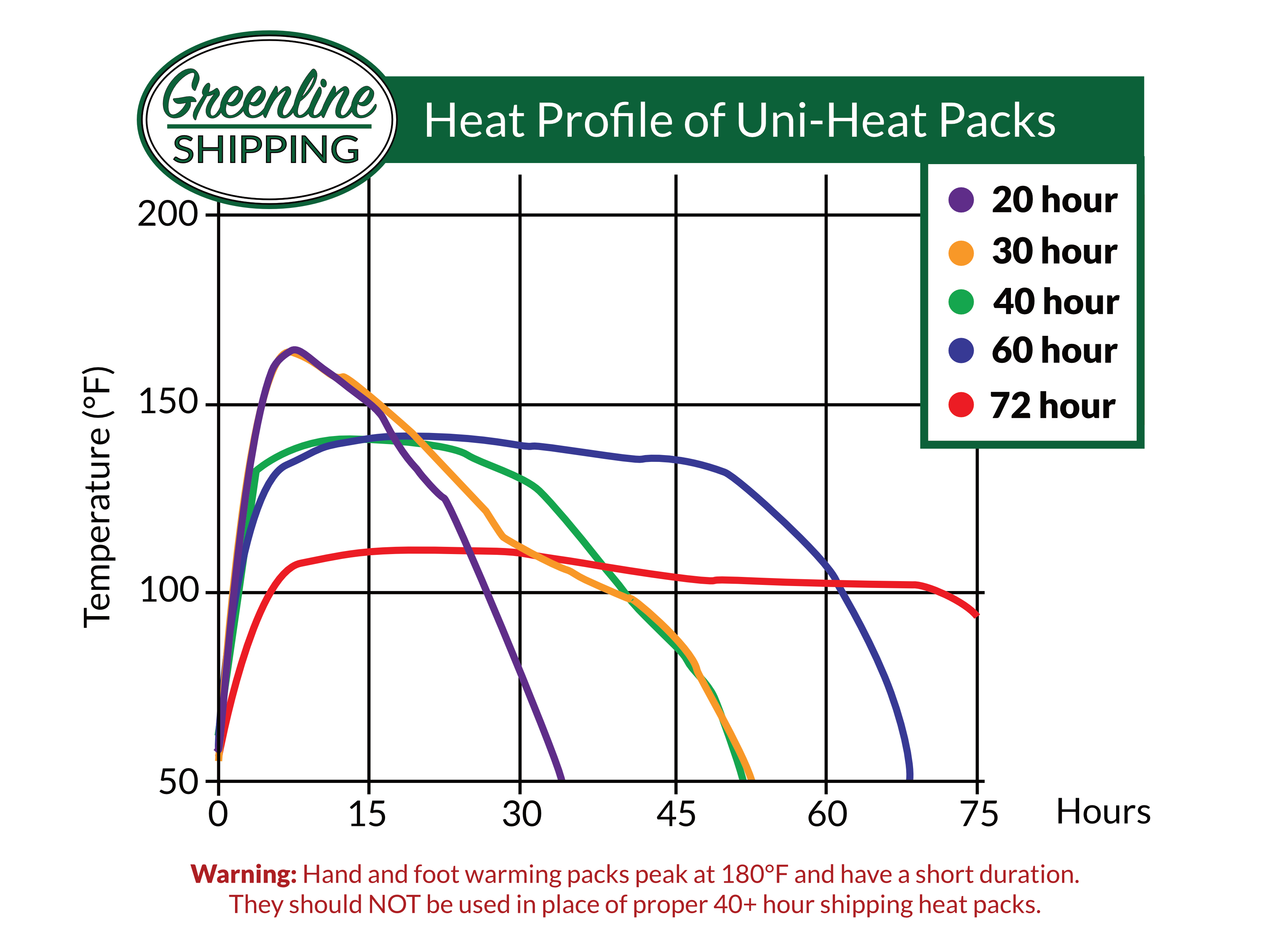
The purpose of a heat pack is NOT to warm or heat the box, it is to prevent it from getting cold. You want a temperate box, NOT a hot box!
If the temperatures are near the lower end of the Greenline Shipping guidelines then doubling the insulation and/or having the shipment held at a FedEx facility will minimize the chances for a DOA.
DOAs are often caused by improper use of heat packs during the winter. Using too many heat packs in a box can cause the inside of the box to overheat. Following these guidelines will increase your chances of having successful shipments.
5 Critical Points for Heat Pack Use
- Activate the heat pack at least an hour before use. Remove outer wrapper, shake vigorously, then wrap in a towel to allow proper heating.
- There should always be crumpled newspaper or other packaging material between the heat pack and the plant.
- Heat packs require oxygen to work. Airholes (two ¼” holes at each end of the box, four holes total) will allow enough oxygen to reach the heat pack.
- The heat pack should never be placed under or over a plant's foliage, as it will likely result in significant damage to foliage. Keep the heat pack by the root system/pot.
- The heat pack should be taped securely to the inside the box (near the roots) so that it cannot shift in transit, BUT DO NOT cover the red stripe with tape! Oxygen must be able to penetrate along the red stripe.
Note: New heat packs are soft and feel like loose powder. Used heat packs are hard. If your heat pack is hard, it has been compromised. Use a different one.
Using a Cold Pack
Soak in water for a minimum of 15 minutes, until fully saturated.
Put the cold pack in your freezer, plastic side down, overnight. It should be fully frozen.
Pack your plant, but don’t place the cold pack until you’re ready for pickup or dropoff. This keeps the cold pack frozen longer.
When you’re ready to seal the package, wrap the cold pack in newspaper to absorb condensation. Tape the pack to the underside of the top insulation panel. Make sure there is packing material (usually crumpled newspaper) between the cold pack and the plant.
Note: Dry Ice is NOT ALLOWED in any Greenline Shipping package. It is strictly prohibited.
Using a Phase Pack
Directions for Use:
Cooling Supplement: Refrigerate the Ship-Safe Phase Pack to pre-cool to the desired temperature. For best results, the temperature should be below the phase change temperature of 74° F.
Heating Supplement: Pre-warm the Ship-Safe Phase Pack in a warm water bath to the desired temperature. For best results, the temperature should be above the phase change temperature of 74° F.
DO NOT MICROWAVE
Ship-Safe Phase Packs are Eco-friendly reusable phase change shipping packs
- Multiple packs may be safely used as Ship-Safe Phase Packs don't generate their own heat
- Ship-Safe Phase Packs may be used in conjunction with heat packs or cold packs to extend effective heating/cooling window
- A popular heat pack substitute for plants, that are sensitive to temperature spikes that come with shipping heat packs
- Ship-Safe Phase Packs are eco-friendly and reusable
- Contents are natural, biodegradable and compostable